
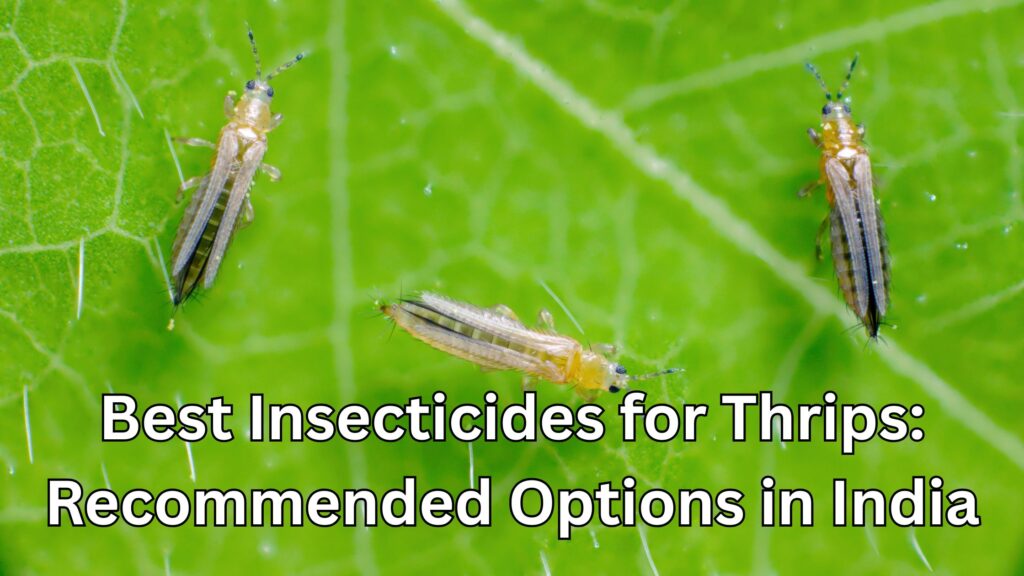
Thrips are among the most difficult sucking pests to control in chilli, onion, cotton, grapes, tomato and many other horticultural and field crops. Their tiny size, rapid multiplication, concealed feeding habit and ability to develop insecticide resistance can make a seemingly minor infestation turn into a serious crop problem.
In India, Thrips parvispinus, Scirtothrips dorsalis and Thrips tabaci are particularly important in different crops and regions. In chilli, severe thrips infestation can cause upward leaf curling, distorted tender growth, scarring, flower damage and substantial loss of yield and market quality.
There is no single insecticide that is universally “best” for every crop, thrips species or location. In 2026, an effective approach is to select a crop-registered insecticide, apply it at the correct stage and rotate products belonging to different IRAC Mode-of-Action (MoA) groups.
How to Identify Thrips Damage
Thrips generally feed by scraping plant tissues and sucking the released cell contents. Because the insects are extremely small, farmers often notice the symptoms before they notice the pest.
Common symptoms include:
- Curling or distortion of young leaves
- Silvery or bronze patches on leaves
- Stunted new growth
- Scarring of fruits
- Damage to flowers and flower buds
- Premature flower drop
- Reduced fruit set
- Black specks of thrips excreta on affected tissues
- Reduced crop vigour under heavy infestation
Check the underside of leaves, tender shoots, flowers and growing points carefully. Blue or yellow sticky traps can also assist in monitoring adult thrips.
Best Insecticides for Thrips in India in 2026
The following active ingredients are important options for thrips management in India. However, registration is crop- and pest-specific. Always verify that the particular formulation is registered for the crop and target pest before application.
1. Spinetoram 11.7% SC
IRAC Group: 5 – Spinosyns
Spinetoram is one of the important modern insecticides used against thrips. It acts primarily on the insect nervous system and has both contact and ingestion activity.
According to the Indian government-approved label for Spinetoram 11.7% SC, it is registered against thrips on crops including chilli, cotton and grapes.
Registered examples
For chilli thrips (Scirtothrips dorsalis), the government label lists:
- Formulation: Spinetoram 11.7% SC
- Formulation dose: 470–500 ml/ha
- Water: 400–500 litres/ha
- Pre-harvest interval: 7 days
For cotton thrips, the label lists 420 ml/ha, while for grape thrips it lists 300 ml/ha. These differences illustrate why the crop-specific label must be followed rather than applying a universal dose.
Why consider Spinetoram?
It can provide strong activity against susceptible thrips populations and represents a different mode of action from neonicotinoids such as acetamiprid and imidacloprid.
2. Spinosad 45% SC
IRAC Group: 5 – Spinosyns
Spinosad is another established option for thrips management. The Government of India’s guidance for management of South East Asian thrips in chilli includes Spinosad 45% SC at 160 g/ml formulation quantity per hectare in 500 litres of water, with a listed waiting period of 3 days. Follow the exact product label because formulation instructions must take precedence.
Important resistance-management point
Spinosad and spinetoram both belong to IRAC Group 5.
Therefore, switching directly from spinetoram to spinosad should not be considered a true Mode-of-Action rotation.
3. Cyantraniliprole 10.26% OD
IRAC Group: 28 – Diamides
Cyantraniliprole is a diamide insecticide with activity against several economically important insect pests.
Indian government guidance lists Cyantraniliprole 10.26% OD among registered insecticides for thrips management in chilli. The same government source lists 600 ml/ha in 500 litres of water, with a 3-day waiting period for the cited chilli recommendation.
Government IPM guidance for tomato also identifies Cyantraniliprole 10.26% OD at 360 ml in 200 litres of water per acre for thrips management.
IRAC classifies cyantraniliprole in Group 28, Ryanodine receptor modulators.
Because its MoA differs from Group 5 spinosyns, it can be useful when designing a resistance-management rotation where its label permits use.
4. Acetamiprid 20% SP
IRAC Group: 4A – Neonicotinoids
Acetamiprid is a systemic insecticide widely used against sucking pests.
The Government of India’s chilli thrips management document includes Acetamiprid 20% SP at 50–100 g/ha in 500–600 litres of water, with a listed waiting period of 3 days.
It can be useful particularly where susceptible thrips populations are present.
However, repeated application of Group 4A insecticides should be avoided as part of an insecticide resistance management strategy.
5. Fipronil 5% SC / Fipronil 80% WG
Fipronil is another insecticide listed by Indian government guidance for chilli thrips.
The government document lists:
Fipronil 5% SC
- 800–1,000 ml/g formulation per hectare
- 500 litres of water
- 7-day waiting period
Fipronil 80% WG
- 50–62.5 g/ha
- 500 litres of water
- 5-day waiting period
Use only the formulation and dose appearing on the current label for your crop.
6. Tolfenpyrad 15% EC
Tolfenpyrad is another option included in Indian government recommendations for chilli thrips.
The cited government guidance lists:
- Tolfenpyrad 15% EC
- 1 litre/ha
- approximately 500 litres water/ha
- 7-day waiting period
It can provide another mode of action for use within an appropriate resistance-management programme where registered.
7. Spirotetramat 15.31% OD
Spirotetramat is particularly notable for its systemic movement within plants and is used against various sucking pests.
For chilli thrips, Indian government guidance includes:
- Spirotetramat 15.31% OD
- 400 ml/g formulation per hectare
- approximately 500 litres water/ha
- 5-day waiting period
IRAC places spirotetramat in Group 23, making it distinct from Group 5 spinosyns and Group 4A neonicotinoids.
8. Diafenthiuron 47% + Bifenthrin 9.4% SC
Combination insecticides can sometimes provide activity against a broader pest complex.
Indian government guidance for chilli thrips includes Diafenthiuron 47% + Bifenthrin 9.4% SC at 625 ml/ha in 500 litres of water, with a listed waiting period of 7 days.
Combination products should not be used simply to compensate for poor spray timing or established resistance. Always follow the registered label.
Quick Comparison of Important Thrips Insecticides
| Active ingredient | Formulation example | IRAC/MoA consideration | Example crop with Indian thrips recommendation |
|---|---|---|---|
| Spinetoram | 11.7% SC | Group 5 | Chilli, cotton, grapes |
| Spinosad | 45% SC | Group 5 | Chilli |
| Cyantraniliprole | 10.26% OD | Group 28 | Chilli, tomato |
| Acetamiprid | 20% SP | Group 4A | Chilli |
| Fipronil | 5% SC / 80% WG | Different MoA from above groups | Chilli |
| Spirotetramat | 15.31% OD | Group 23 | Chilli |
| Tolfenpyrad | 15% EC | Different MoA option | Chilli |
| Diafenthiuron + Bifenthrin | 47% + 9.4% SC | Combination product | Chilli |
The table is intended for comparison rather than as a universal spray schedule. Crop registrations and label directions must be checked before use. Indian government guidance lists a broader set of approved options for chilli thrips, including several of the active ingredients above.
Which Insecticide Is Most Suitable for Severe Thrips Infestation?
The answer depends on the crop, thrips species, previous pesticide history and local resistance status.
For crops where they carry a current label claim, modern options such as spinetoram, cyantraniliprole and spinosad may be important components of a thrips-management programme. However, repeatedly spraying the same active ingredient—or repeatedly changing brand names while using the same IRAC group—can accelerate resistance.
IRAC recommends rotating or sequencing insecticides from different Mode-of-Action groups and integrating chemical treatment with other pest-management measures.
Suggested Mode-of-Action Rotation Concept
Rather than thinking:
Brand A → Brand B → Brand C
think:
MoA Group A → MoA Group B → MoA Group C
For example, where each product is registered for the particular crop/pest, a programme might move among:
Group 5 → Group 28 → Group 4A/another effective registered MoA
The exact programme should be based on crop stage, local pest pressure, previous applications and current label recommendations.
Do not treat Spinosad → Spinetoram as a full MoA rotation because both are Group 5 spinosyns. IRAC specifically emphasizes alternation among different MoA groups to reduce resistance selection pressure.
Why Do Thrips Sometimes Survive After Insecticide Application?
Failure does not automatically mean that the insecticide is ineffective.
Common reasons include:
1. Insecticide resistance
Repeated use of the same chemistry can select resistant thrips populations.
2. Poor spray coverage
Thrips frequently remain inside flowers, curled leaves and protected growing points. A spray that fails to reach these locations may provide inadequate control.
3. Incorrect insecticide selection
A product effective against caterpillars, aphids or whiteflies is not automatically effective against thrips.
4. Spraying too late
Control becomes more difficult once populations are extremely high and substantial crop damage has already occurred.
5. Incorrect dose
Using below-label doses may reduce efficacy and contribute to resistance selection, while excessive doses can create residue, crop-safety and environmental problems.
6. Repeated use of the same MoA
Changing brands does not necessarily mean changing chemistry. Always check the active ingredient and IRAC group.
Integrated Pest Management for Thrips
Chemical control should form only one part of a broader Integrated Pest Management (IPM) programme.
Monitor the Crop Regularly
Inspect tender leaves, flowers and growing points. Early detection makes management easier.
Use Sticky Traps
Blue or yellow sticky traps can assist with monitoring adult thrips populations.
Remove Heavily Infested Plant Material
Where practical, remove severely affected shoots or crop residues that may maintain pest populations.
Control Weeds
Weeds surrounding the crop can act as alternate hosts for thrips.
Avoid Excessive Nitrogen
Excessive nitrogen can encourage soft vegetative growth that may favour some sucking-pest infestations.
Protect Beneficial Insects
Predatory insects and mites can contribute to thrips suppression. Avoid unnecessary broad-spectrum pesticide applications.
Rotate Insecticide Modes of Action
IRAC recommends using insecticides as part of an integrated programme and rotating different MoA classes rather than repeatedly exposing pest generations to the same mode of action.
Important Precautions Before Spraying
Always:
- Read the pesticide label before application.
- Confirm that the insecticide is registered for the specific crop and target pest.
- Follow the label dose and water volume.
- Observe the specified pre-harvest/waiting period.
- Use appropriate personal protective equipment.
- Avoid unnecessary tank mixtures.
- Avoid repeated applications from the same IRAC group.
- Follow local agricultural department, KVK, SAU or authorised crop-adviser recommendations where resistance is suspected.
Never assume that a dose recommended for chilli can automatically be used on onion, tomato, cotton, grapes or another crop.
FAQs About Thrips Insecticides
1. What is the best insecticide for thrips in India in 2026?
There is no single best insecticide for every situation. Depending on crop registration and local susceptibility, important options include spinetoram, spinosad, cyantraniliprole, acetamiprid, fipronil, spirotetramat and tolfenpyrad. Indian government guidance lists several of these for chilli thrips management.
2. Is Spinetoram effective against thrips?
Yes. Spinetoram 11.7% SC has Indian label claims against thrips in crops including chilli, cotton and grapes. For chilli, the cited government label recommends 470–500 ml/ha against Scirtothrips dorsalis.
3. Is Spinosad good for thrips?
Spinosad is an established thrips insecticide and is included in Indian government guidance for chilli thrips. However, spinosad and spinetoram both belong to IRAC Group 5, so they should not be treated as different MoA options when planning resistance rotation.
4. Can Cyantraniliprole control thrips?
Yes, on crops for which it has an appropriate label claim. Indian government IPM guidance, for example, recommends Cyantraniliprole 10.26% OD against thrips in tomato, and government chilli guidance also lists the formulation for thrips.
5. Why does the same insecticide stop controlling thrips?
One possible cause is resistance created by repeated selection pressure. Other causes include inadequate spray coverage, incorrect timing, incorrect dose, high pest pressure or spraying a product that is not suitable for the target species/crop. IRAC recommends rotating different MoA groups and integrating insecticides with other IPM measures.
6. Can I mix two insecticides for better thrips control?
Do not make arbitrary insecticide mixtures. Use only combinations permitted by labels or recommended by competent agricultural authorities. Unnecessary mixtures can increase cost, residues and effects on beneficial organisms without necessarily solving resistance.
7. How often should insecticides be sprayed for thrips?
There is no universal interval. Follow the product label and base treatment on pest monitoring, crop stage and local recommendations. Routine calendar spraying should be avoided where possible.
8. Can neem products control thrips?
Neem/azadirachtin products can form part of an IPM programme, particularly under lower pest pressure, but performance can vary with infestation level, formulation, coverage and application timing. They should not be assumed to provide rapid rescue control during every severe outbreak.
9. What is the best way to prevent insecticide resistance in thrips?
Use insecticides only when justified, follow label rates, achieve good coverage and rotate among different IRAC Mode-of-Action groups rather than merely changing brands. IRAC identifies MoA rotation as a central resistance-management strategy.
10. Which insecticide should be used for Thrips parvispinus?
Management should be based on the affected crop and locally registered products rather than the thrips species alone. The Directorate of Plant Protection, Quarantine & Storage has published specific monitoring and management guidance for South East Asian thrips (Thrips parvispinus), including a list of registered insecticides for chilli.
Conclusion
Successful thrips management in 2026 is less about repeatedly searching for the “strongest” pesticide and more about correct identification, early detection, good spray coverage, crop-specific registration and insecticide resistance management.
Active ingredients such as Spinetoram 11.7% SC, Spinosad 45% SC, Cyantraniliprole 10.26% OD, Acetamiprid 20% SP, Fipronil, Spirotetramat and Tolfenpyrad are among the important chemical options referenced in Indian thrips-management guidance, depending on the crop.
For sustainable control, integrate these products with monitoring, sanitation, weed management, biological control and—critically—rotation among different IRAC Mode-of-Action groups.
Disclaimer: This article is for educational purposes. Pesticide registrations, approved crops, target pests, formulations, doses and waiting periods can change. Always follow the current CIB&RC-approved product label and applicable Indian regulations before pesticide application.